Oman E-invoicing: What Do We Know By Now?
The Sultanate of Oman is rapidly advancing its invoicing solutions as it joins the list of countries implementing E-invoicing instead of traditional manual invoicing. This digital transformation agenda was introduced under what the Oman Tax Authority ( OTA ) has called the “Fawatra” program.
With the introduction of this official national E-Invoicing program, Oman joins other neighboring countries in the Middle East including Saudi Arabia, Jordan, Egypt, UAE, and Qatar among other upcoming countries.
The Oman Tax Authority (OTA) is following a phased mandate similar to Saudi Arabia that requires businesses to transition to the new national E-invoicing system “Fawtara” to ensure all invoices are exchanged in a standardized format.
Understanding This E-invoicing Mandate Matters,
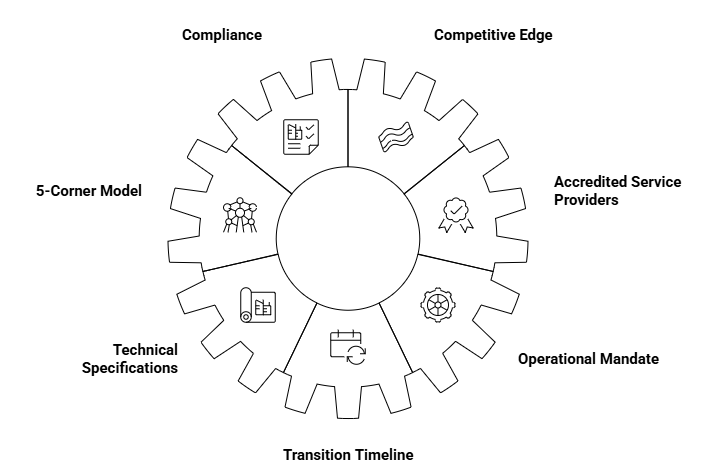
For all companies operating in Oman, grasping the new Fawtara E-invoicing updates is critical for compliance and maintaining a competitive edge. The OTA’s program is a fundamental shift, moving to the 5-Corner Model and requiring the use of Accredited Service Providers (ASPs). With the official technical specifications expected imminently, businesses must be prepared to ensure a smooth transition to the mandatory phases beginning in August 2026.
Phase One is Underway: Key Timelines and Criteria
The OTA has announced its initiation process of the first mandatory phase of Fawtara, targeting approximately 100 selected top businesses as a pilot group.
Oman E-invoicing: Selection Criteria
The OTA is selecting participants based on a set of factors that includes the business size (large enterprise, SMEs…etc), sector, annual invoice volume, technical readiness. The phases are set to be implemented in 4 phases as follows.
Phase 1:
Includes 100 large VAT-registered companies, begins in August 2026.
Phase 2:
All large VAT-registered companies, begins in February 2027.
Phase 3:
All remaining VAT-registered taxpayers, begins in August 2027.
Phase 4:
Government institutions and entities, begins in February (year yet to be announced).
Oman E-invoicing: Important Dates Timeline
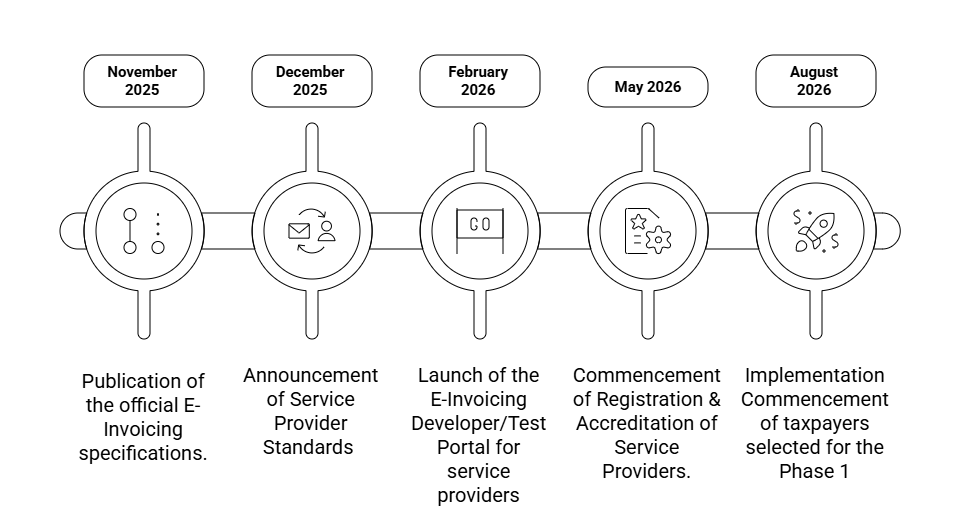
The OTA has outlined the following key milestones leading up to the Phase 1 commencement:
| Date | Milestone |
| November 2025 | Publication of the official E-Invoicing specifications. |
| December 2025 | Announcement of Service Provider Standards and commencement of discussion workshops. |
| February 2026 | Launch of the E-Invoicing Developer/Test Portal for service providers. |
| May 2026 | Commencement of Registration and Accreditation of E-Invoicing Service Providers. |
| August 2026 | Implementation Commencement of taxpayers selected for the First Phase. |
5-Corner Model Implementation for E-invoicing in Oman
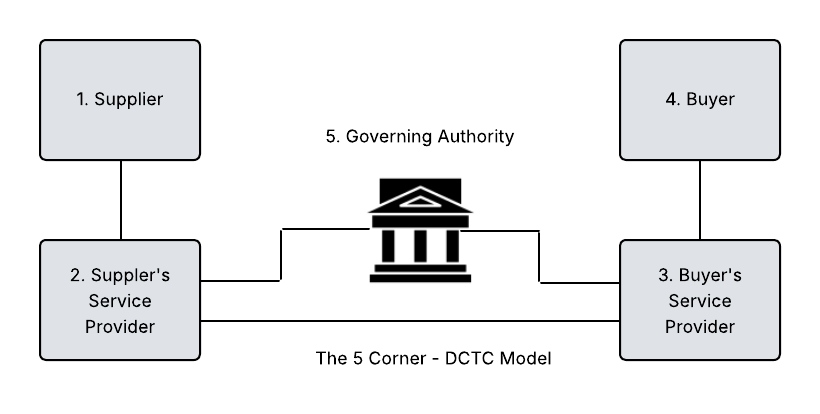
The Fawtara E-invoicing program is built on the internationally recognized 5-Corner Model (Peppol CTC) for E-invoicing. This model establishes a standardized, controlled, and decentralized mechanism for invoice exchange, moving away from direct government reporting.
The 5-corner model can be considered as an extension of the 4-corner model, but with the addition of a fifth corner, which in this case is the Oman Tax Authority (OTA). It follows a decentralized CTC framework model. In the Peppol CTC Model. The transaction is shared through the network’s 4 corners but is simultaneously also reported to a fifth corner (OTA).
How Does The 5-Corner Model Work?
- The supplier system issues the electronic invoice.
- The invoice is routed through the Supplier’s Certified Service Provider (or Access Point/AP).
- The Service Provider validates the invoice against OTA specifications and exchanges it with the Customer’s Service Provider.
- The Customer receives the validated invoice data via their own Service Provider.
- Simultaneously, key transaction data is sent to the fifth corner for real-time monitoring.
The OTA’s goal is to Strengthen tax compliance, reduce fraud, and facilitate the digital transformation of the Omani economy.
Why This Transformation Matters for Businesses in Oman
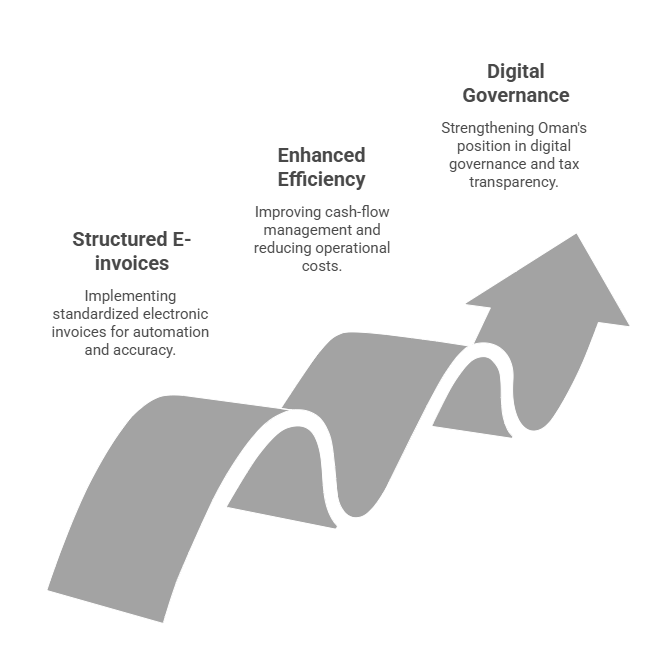
The move toward Fawtara is not just a regulatory step but a strategic opportunity for Omani businesses. Structured electronic invoices enable automation, faster approvals, and greater data accuracy while ensuring fairness to everyone.
Early implementation for businesses of the E-invoicing system in Oman enables them to gain an advantage to better manage cash-flow and enhance their operational efficiency, while reducing errors and manual processing costs.
The Fawtara program strengthens Oman’s position in digital governance and tax transparency by fostering a trustworthy invoice lifecycle management for businesses, governments, and customers equally.
Benefits Beyond Compliance
- Operational Efficiency: Automated validation and archiving reduce manual effort and speed up approvals.
- Data Integrity: Standardized fields and real-time checks reduce invoice rejections and disputes.
- Sustainability: Reducing paper usage supports environmental goals and digital sustainability
- Regional Alignment: As more GCC countries adopt similar models, Oman’s system ensures interoperability and future cross-border compatibility.
- Universal Standards: By implementing the 5-Corner Model; also known as Peppol CTC, The Omani Tax Authority follows global standards for managing electronic documents such as e-invoices according to a widely adopted model around the Globe.
The Role of Accredited Service Providers (ASPs)
E-invoicing service providers will act as the bridge between taxpayers and the OTA. They will perform the validation, transmission, and archiving of E-invoices securely according to OTA standards for the 5-Corner Model.
Selecting the right provider is crucial. For larger enterprises operating across the GCC or different countries around the world, working with a multi-country solution can simplify compliance across jurisdictions.
InvoiceQ’s Regional Expertise
InvoiceQ currently supports compliant E-invoicing across Saudi Arabia, Jordan, Egypt, Qatar, and the UAE, aligning with each country’s local tax authority requirements. The platform’s regional presence and experience with real-time reporting models such as ZATCA in Saudi Arabia and ISTD in Jordan make it well-positioned to help Omani businesses transition smoothly to Fawtara once it launches.
Moreover, as a certified Peppol Access Point, InvoiceQ can also facilitate interoperability with the emerging Peppol-based framework in the UAE and Oman for future cross-border initiatives within the GCC and MENA Region.
Why Do Businesses Across The MENA Region Choose InvoiceQ?
With a strong regional track record and deep expertise in digital compliance, InvoiceQ stands out as a trusted e-invoicing partner across the MENA region. Our platform combines regulatory readiness, scalability, and advanced automation to help businesses adapt confidently to evolving mandates such as Oman’s Fawtara program.
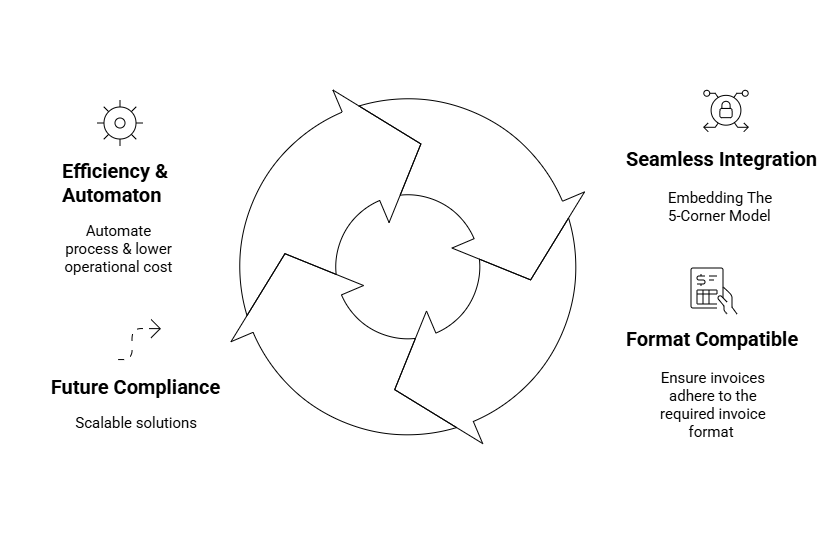
- Seamless 5-Corner Integration: As an accredited Peppol AP, we ensure a trusted implementation of the 5-Corner Data Exchange Model required to legally exchange and validate invoices between all corners involved with the tax authority (OTA) via the Peppol network.
- Format Compliance: InvoiceQ guarantees that every electronic invoice generated meets the precise invoice data structure mandated by the Tax Authority (OTA).
- Future-Proof Compliance: As the OTA expands the mandate to include more medium and small enterprises (SMEs) in later phases (2026 and beyond), our solution scales with you, eliminating the need for costly internal IT overhauls.
- Automation & Efficiency: Transitioning to Fawtara with InvoiceQ means faster transaction cycles, reduced administrative burden, and enhanced data accuracy all contributing to lower operating costs.
InvoiceQ: Cross-Market Alignment
Oman’s adoption of Fawtara aligns closely with other MENA region initiatives such as Saudi Arabia’s ZATCA’s Fatoora platform, Jordan’s ISTD Jofotara, and Egypt ETA’s E-invoicing system. This regional convergence shows a clear direction toward real-time tax reporting and cross-border data compatibility. Businesses operating in multiple markets can use this alignment to implement unified systems and avoid duplicate data.
Conclusion
The Fawtara E-Invoicing initiative marks a significant milestone in Oman’s digital tax transformation. It will modernize how businesses issue, exchange, and report invoices, enhance transparency, and reduce fraud. Companies that act early by upgrading their systems and partnering with trusted E-invoicing service providers such as InvoiceQ will not only ensure compliance but also gain a competitive advantage in efficiency and data-driven operations.