Introduction
Searching for the best E-invoicing system in Jordan is no longer a tech luxury or an optional tool for business owners. It has become a critical and essential requirement to ensure tax compliance, especially with the mandatory implementation of the National E-Invoicing System (JoFotara).
And with the increased monitoring by the ISTD and clearer technical and legal requirements, choosing a compliant E-invoicing system has become a necessary step for any business seeking operational continuity and avoiding violations that may impact the stability of the business.
In this article, we review the key criteria for selecting the most suitable E-invoicing system, highlight the fundamental differences between available solutions, and explain why InvoiceQ’s E-invoicing system is considered one of the best choices in Jordan as an approved solution that enables seamless integration with the National Invoicing Platform (JoFotara).
What is An E-Invoicing System in Jordan?
E-invoicing in Jordan is a comprehensive digital framework designed to transform invoice issuance from paper-based or manual processes into structured electronic formats approved according to standards defined by the Income and Sales Tax Department (ISTD). These invoices are transmitted either in real time or through scheduled batches to the official JoFotara platform, which is operated by the ISTD.
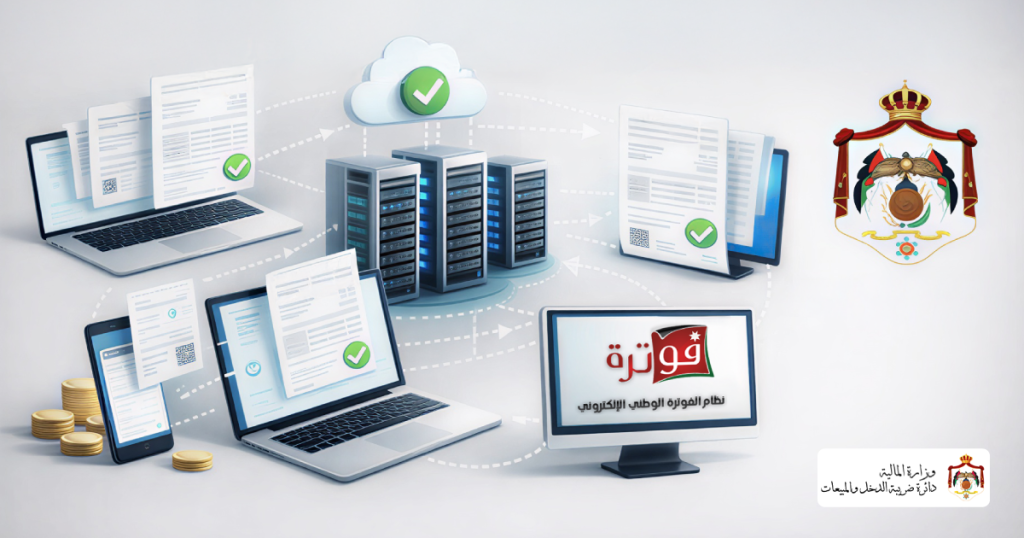
The main objectives of E-invoicing in Jordan include:
- Organizing invoice issuance processes: By defining how businesses generate and manage their sales invoices.
- Standardizing tax data formats: Ensuring all invoices contain the required technical elements such as the Tax Identification Number, QR code, and item details.
- Reducing manipulation and manual errors: Limiting reliance on manual data entry and improving the accuracy of accounting records.
- Enhancing tax transparency and oversight: Allowing the tax authority to obtain a clearer view of actual economic activity in the Kingdom.
- Simplifying auditing and reconciliation processes: Accelerating VAT refund processes and reducing the time required for tax audits.
Why is Choosing an E-Invoicing System Important in Jordan?
With the mandatory transitioning toward E-invoicing in Jordan, it is no longer sufficient to rely on tools such as Excel, Word, or other simple E-invoice document generator tools that create invoices but do not comply with the official regulatory format.
Using such tools prevents companies from achieving the required electronic integration, since they are not designed for the technical connection with The National E-invoicing system. Any issue in invoice format or delays in submission may expose companies to penalties, rejected invoices, or even refusal from buyers to transact with vendors that do not issue compliant invoices.
Choosing The Best E-invoicing System in Jordan Ensures:
1. Full tax compliance: Meeting regulatory requirements with 100% accuracy.
2. Protection from penalties: Avoiding fines related to non-compliance.
3. Business continuity: Ensuring sales operations are not disrupted due to technical failures.
4. Future readiness: Adapting to any updates issued by the tax authority without needing to replace your system..
Who is Required to Use an E-Invoicing System?

The compliance scope has expanded to include most sectors in Jordan, including VAT-registered taxpayers, Professionals such as doctors and lawyers, Companies of all sizes operating taxable activities, and freelancers. Even exempt sectors may still be required to issue E-invoices to document financial transactions and ensure buyers can prove their expenses.
In other words, exemption applies only to financial penalties, but it does not necessarily eliminate the requirement to integrate with the National E-invoicing System. Businesses may still need to issue compliant invoices to maintain trust and operational compatibility with buyers or businesses.
For more details about mandated and exempt entities, you can review the full details through this article and check our video guide.
Key Criteria for Choosing The Best E-Invoicing System in Jordan
When evaluating available solutions, price alone should not be the deciding factor. The following criteria must be considered:
1. Technical Compliance with the National E-Invoicing System (JoFotara)
- The system must be according to technical specifications defined by the ISTD and capable of:
- Generating invoices in XML format or other required structures
- Transmitting invoices in real time
- Supporting direct integration with the Jofotara E-invoicing platform
- Handling internet outages by storing invoices and sending them once connectivity is restored.
2. Official Accreditation and Local Expertise
The Jordanian market has specific invoicing requirements under The Income and Sales Tax Department. The best systems are those supported by local technical and legal teams capable of monitoring regulatory updates and implementing them immediately while providing support in both Arabic and English within local time zones.
3. Ease of Use and User Experience
The system should not be complicated. A successful E-invoicing system allows users to issue compliant invoices easily without requiring advanced technical knowledge.
4. Integration and Connectivity
This is particularly important for companies that already use existing systems. The ideal E-invoicing solution acts as middleware, connecting your current system (such as SAP, Oracle, QuickBooks, or Microsoft Dynamics) with the National E-invoicing System without the need to replace your current system.
Are All E-Invoicing Systems the Same?
There is a common wrong assumption that all systems that issue E-invoices are in E-invoicing systems. In fact, there is quite some difference. Solutions can generally be categorized into the following types:
1. Accounting and Financial Systems: These systems manage accounting operations, financial reports, and bookkeeping activities within a company. While they may generate invoices electronically, they are not necessarily designed to meet the technical requirements for direct integration with the ISTD.
2. POS Systems (Point of Sale): POS systems are designed to manage daily retail transactions and issue receipts at checkout points. Although they generate invoices, these invoices are not always tax-compliant electronic invoices, creating a challenge for businesses that need to connect them to the ISTD.
3. ERP Systems (Enterprise Resource Planning): ERP platforms manage a wide range of enterprise resources including accounting, procurement, inventory, and HR. Invoicing is typically only one component of a larger operational ecosystem.
4. Specialized E-Invoicing System Such As InvoiceQ: These systems are specifically designed to issue and receive tax-compliant electronic invoices and integrate directly with the Income and Sales Tax Department (ISTD). They allow direct connection with the National E-invoicing System (JoFotara) without requiring intermediary systems.
InvoiceQ’s Role in Shaping Jordan’s Digital Transformation?
InvoiceQ is considered one of the leading E-invoicing providers in Jordan. The platform offers specialized invoicing solutions as well as integration services for accounting systems, ERP, and POS systems, enabling businesses to connect with the Income and Sales Tax Department without replacing their existing systems.
These fintech solutions have made InvoiceQ the preferred choice for many large enterprises, SMEs, and individual professionals across Jordan and the wider Middle East.
What Makes InvoiceQ The Best E-Invoicing System in Jordan?

- Secure Direct Integration: InvoiceQ provides a seamless connection with the National E-invoicing System, ensuring every invoice reaches the tax authority accurately and legally.
- Automated Validation: The system verifies invoice data before submission, ensuring tax numbers and calculations are correct and minimizing rejection rates.
- System Independence: InvoiceQ operates as an independent platform that enables businesses to manage invoicing and compliance simultaneously.
- Advanced Dashboard: Decision-makers gain full visibility over sales activity, accepted invoices, and tax reports, along with flexible role and permission management.
Common Mistakes When Choosing An E-Invoicing System
To avoid future complications, businesses should avoid the following mistakes:
- Choosing the cheapest solution only: Low-cost systems may lack cybersecurity protection or proper technical support.
- Ignoring scalability: The system should handle increasing invoice volumes without performance issues.
- Overlooking security certifications: Invoices contain sensitive financial information and must be protected through encryption and secure infrastructure.
- Failing to train employees: Even the best system will fail to deliver value if staff members are not properly trained to use it.
Start Your E-Invoicing Journey with InvoiceQ
If you want to transition smoothly into E-invoicing, you can follow these steps with the support of the InvoiceQ team:
1. Assess your current setup: Identify the accounting system you currently use and determine the best integration method.
2. Prepare your tax data: Ensure that your tax numbers and customer records are accurate and up to date.
3. Contact an approved provider: Such as InvoiceQ to request a demonstration and understand how the system integrates with your operations.
4. Testing phase: Generate test invoices to confirm that everything functions properly.
5. Official launch and training: Begin issuing real invoices and train your accounting team on reporting and invoice monitoring.
6. Ongoing support: With InvoiceQ as your provider, you will receive continuous technical support even after deployment to ensure smooth operations.
Conclusion
Choosing the best E-invoicing system in Jordan is no longer merely a technical decision; it has become a strategic advantage that directly affects your company’s compliance and financial stability.
With the digital transformation led by the ISTD, InvoiceQ provides a reliable solution that simplifies integration with JoFotara while ensuring full compliance with the highest standards of security and efficiency.